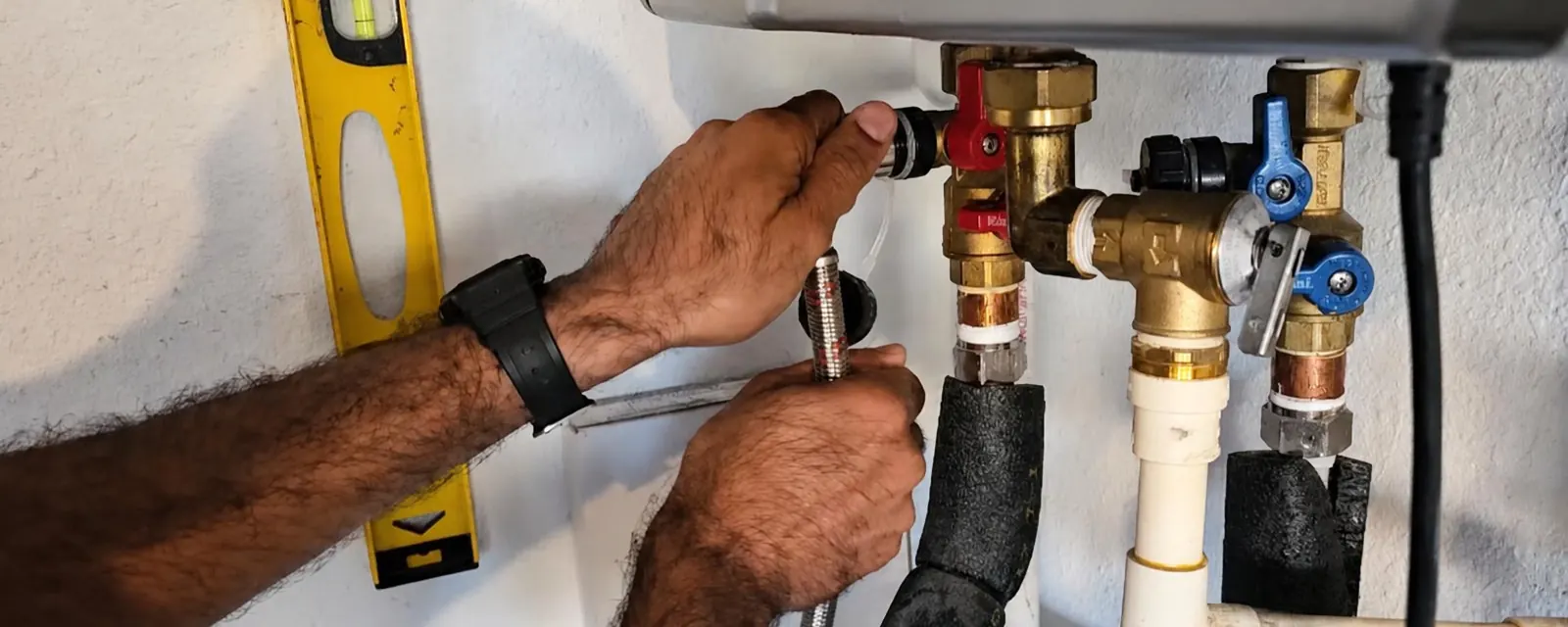
A tankless water heater heats water only when you open a tap. There is no tank to fill, so turning one on is about confirming four supplies: water, power, fuel and a clear vent. If any one is off, the unit will not fire, and it may show an error code.
Use this guide after a power cut, a long absence, a repair or a flush. If you smell gas at any time, leave the house and call the gas utility or 911 before you call a plumber.
Before you turn it on: the safety check
If you smell gas
Do not touch switches, light anything or use a phone inside. Leave the building, then call the gas utility or 911. Call a plumber only after the gas supplier clears the building.
- The vent pipe is connected, unobstructed and not blocked by snow or a nest.
- The area around the heater is clear of stored items.
- The water supply valves are open and no leaks show at the connections.
- The gas valve is in the open position, parallel to the pipe, on gas models.
- The electrical cord is plugged in or the breaker is on.
Start-up steps
- Open the water valvesOpen both the cold inlet and hot outlet isolation valves. Open a hot tap nearby to let air out of the lines.
- Restore powerPlug in the unit or flip the breaker. The display should light up, and some models run a self-check.
- Open the gas valveOn gas models, turn the gas shutoff handle so it lines up with the pipe.
- Set the temperatureUse the remote or the panel to pick a setting. Lower settings reduce scale buildup and scalding risk.
- Run hot waterOpen a hot tap fully. The heater should ignite within seconds and deliver hot water after a short delay.
If the burner does not light, close the tap, wait a minute and try again. Some units need a minimum flow rate to fire, so open the tap farther. A low-flow faucet or a clogged aerator can keep the unit from starting.
Common reasons a tankless heater will not fire
| Symptom | Likely cause | What to try |
|---|---|---|
| No display | No power or tripped breaker | Check the plug, breaker and GFCI |
| Display on, no heat | Gas valve closed or low gas pressure | Confirm the gas valve and other gas appliances |
| Cold water sandwich | Flow too low or scale in the heat exchanger | Open the tap farther, plan a flush |
| Error code flashes | Vent, ignition or flow issue | Look up the code, reset once |
| Water too hot or too cold | Setting or mixing issue | Check the temperature and the faucet balance |
A reset clears minor faults. Turn the power off for a minute and back on. If the same code returns after one reset, stop and call a plumber, because repeated attempts can overheat the unit.
Flushing and descaling: the routine that keeps it running
Scale collects inside the heat exchanger and cuts flow. Most makers recommend an annual flush with a descaling solution, and more often in areas where scale builds quickly. A flush takes about an hour and uses a small pump and two hoses.
Skip it and the unit works harder, runs hot and eventually trips a high-limit error. Our tankless water heater page covers install, repair and flush work. If a unit is worn out, replacement may be the better value.
What Londonderry homes need for a tankless install
A gas tankless unit needs a gas line sized for the burner, a proper stainless or PVC vent, a condensate drain on condensing models and a power outlet. Electric models need heavy circuits, which can mean a panel upgrade.
Cold weather matters. In New Hampshire winters, the incoming water is colder, so the heater must raise the temperature more, and flow rates drop. Size the unit for the winter, and ask for the maximum flow at your coldest incoming temperature.
Old galvanized supply pipes can also limit flow to the heater. See repiping if your pipes are old and restricted.
When to stop and call a plumber
Call for service if the unit shows the same error after one reset, if you see water around the base, if the vent looks damaged or if you smell exhaust or gas. Do not remove covers or adjust gas pressure yourself.
A tankless heater that cycles on and off with the tap fully open is a flow problem and often a scale problem. A flush fixes many of these. Our 24/7 line at (603) 815-9179 is open if the house has no hot water and the weather is cold.
Londonderry, NH note: water, wells and permits
Water quality affects how fast a tankless heater scales. We cannot publish a hardness number for Londonderry, because town water and private wells differ. Test your tap and ask your water utility for its water quality report, then set your flush schedule from the results.
Many Londonderry residents are on private wells, so ask NHDES about testing programs and whether treatment before the heater makes sense. Before a gas or vent change, check with the town's Building and Zoning Enforcement staff on 603-432-1100, extension 440.
We install and service tankless units in Londonderry, Windham and Litchfield.
What tankless service costs
Startup help is priced before we begin, and a repair found along the way is quoted separately. The total depends on:
- Whether you need a flush, a repair or an install.
- Gas line, vent and electrical upgrades.
- Unit size and efficiency rating.
- Condition of the water lines and valves.
- After-hours service.
Insurance does not usually cover wear or scale. Call (603) 815-9179 for a real number.
Tankless venting and relief piping follow the manufacturer's instructions and the International Plumbing Code (IPC) where it applies.
Questions we hear in Londonderry
The flow is too low or scale is restricting the heat exchanger. Open the tap farther and plan a flush.
Once a year is common, and more often if your water makes scale. Check the maker's guide and your test results.
Most units need power for the electronics, even on gas. They do not run during an outage without a backup.
Reset once. If the code returns, call a plumber.
Colder incoming water means the heater must work harder and flow drops. Size the unit for winter conditions and keep the vent clear of snow.