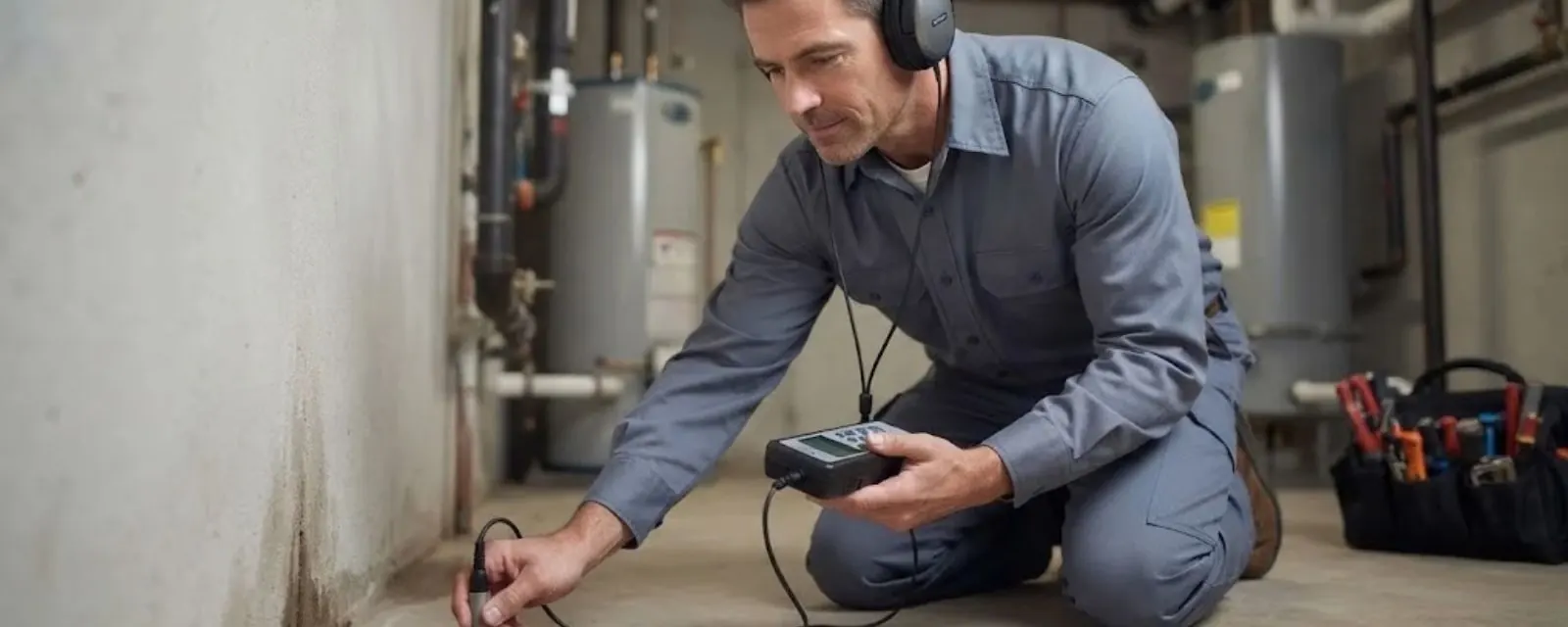
Leak detection is the work of finding exactly where water is escaping from a pipe, so the repair opens one small area and not half a wall. A leak that soaks drywall or floods a basement is an emergency, and our 24/7 line takes those calls at night and on weekends, with same-day dispatch when schedules allow.
If water is actively spreading, shut off the main valve where the supply enters the house. Turn off power to any wet room from the breaker panel if you can reach it safely, and move belongings out of the wet area. Then call (603) 815-9179 and tell the dispatcher what you see and where.
Many leak calls start with a symptom and not a diagnosis. A bill that creeps up, a stain that grows, a warm patch on the floor and a pump that never stops all point the same way, and the sections below match each symptom to a search method.
Signs of a hidden leak, and when to call it an emergency
Slow leaks hide for months. Fast leaks announce themselves. Knowing which one you have decides whether you call tonight or tomorrow morning.
| What you notice | What it usually means | How urgent |
|---|---|---|
| Water bill higher than usual with no change in habits | Slow leak on the supply side or a running toilet | Call within days |
| Meter dial moves with every fixture off | Leak between the meter and the fixtures | Call today |
| Brown stain spreading on a ceiling | Supply or drain leak above, often inside a wall or floor | Call today, tonight if it is wet |
| Sound of running water in a quiet house | Active leak in a wall, slab or buried line | Call tonight |
| Warm spot on a floor or a hot water bill spike | Leak on a hot line under the floor | Call today |
| Water dripping through a light fixture or bulging ceiling | Large active leak | Emergency, shut off the main |
Any leak that is near electrical fixtures, soaking insulation or running down walls belongs in the emergency column. Do not wait to see if it dries.
Water meter still running or a high water bill
A meter that keeps turning when every fixture is off is the clearest sign of a leak. Shut off all taps, the dishwasher and the washing machine, then check the meter dial or the small low-flow indicator for movement. If it moves, water is escaping somewhere downstream of the meter.
From there we split the system in two by closing the main valve inside the house. If the meter stops, the leak is inside the building. If it keeps moving, the leak is on the buried line between the meter and the house.
Many Londonderry homes are on private wells and have no water meter and no water bill. For those homes the warning signs are different: the well pump cycles on and off when nobody is using water, the pressure tank loses charge quickly, or the electric bill climbs. A pressure test on the house plumbing tells us whether the loss is inside the walls or before them.
Ceiling, wall and attic leaks
Water travels. A stain on a ceiling is rarely directly below the leak, because water runs along joists and pipes before it finds a place to drop. A moisture meter and a thermal camera show the damp path, and the starting point is usually uphill of the stain.
We check supply lines, drain lines and shower pans above the stain before suggesting a roof or window cause. A roof leak will usually leave water only after rain, while a plumbing leak shows up on dry days too. Attic leaks near a water heater or a heating pipe are common in winter, when a joint can weep as the pipe expands and contracts.
Once we mark the source, the repair opens an area the size of a dinner plate and not a whole ceiling. Our burst pipe repair page explains what happens when the pipe has actually split.
Basement, crawlspace and under-house leaks
Many New Hampshire homes sit over a basement or crawlspace, which makes the underside of the house the easiest place to inspect. Wet joists, rusty hangers, a damp sill or a dripping fitting under a bathroom are all visible with a flashlight and a ladder.
The harder case is groundwater that looks like a leak. A damp basement floor after heavy rain is not always a plumbing problem. We test the supply lines first and report honestly when the water is coming from outside the house, because that fix belongs to a waterproofing or drainage contractor and not a pipe repair.
Under-house drain leaks are the second suspect. A cracked drain below a toilet or tub drips only when that fixture is used, and a dye test confirms which fixture is the source.
Buried lines, the yard and the meter box
The line from the street or the well to the house runs underground, and a leak there can go unseen for months. Warning signs include a soft or unusually green patch of lawn, a wet spot in dry weather, and pressure that drops through the day.
We pinpoint buried leaks with ground microphones that hear the hiss of escaping water, then confirm with pressure isolation. A leak at the meter box is a separate case. Water pooling in the box or around the curb stop usually means a failed fitting, and we can often replace it without digging far.
If the buried line itself has failed, the repair or replacement is covered on our water service line repair page.
Slab leaks in a basement region
A slab leak is a leak in a pipe running through or beneath a concrete floor. Slab-on-grade houses are less common in New Hampshire than in warmer states, since most homes here are built over basements. That is good news, because most supply lines run in the open where they can be reached.
Slab leaks still happen in additions, garages, finished walkout levels and some newer homes built on a slab. Signs are a warm floor, the sound of running water and a wet carpet edge. We locate the line with acoustic and thermal tools, then offer a spot repair, a reroute or a repipe, depending on pipe age.
Irrigation and pool leaks
A sprinkler zone that runs weakly or floods one corner of the lawn usually has a cracked fitting or a broken head. We check the zone valves and pressure, trace the wet line and repair the damaged piece. Winterizing the system before the first hard freeze prevents most of this damage.
Pool and spa plumbing leaks are tested by isolating each line and holding pressure. We test the supply and return lines that run between the equipment and the water, and we refer shell and liner leaks to a pool specialist.
How we find the leak without tearing things open
- Interview and meter checkWe ask what you have seen, then test the meter or the well system to confirm that water is actually being lost.
- Pressure isolationWe shut off sections of the plumbing and watch the gauge to narrow the search to a single run of pipe.
- Listening and imagingAcoustic microphones, a thermal camera and a moisture meter pinpoint the spot, and a drain camera checks waste lines.
- Marking and optionsWe mark the leak, explain the repair choices and give you a clear price before work starts.
Commercial properties with multiple restrooms or a fire line need a longer survey, which our commercial plumbing team handles.
What leak detection costs
Pricing depends on how hard the leak is to reach. These factors drive the number:
- How many zones or floors have to be tested.
- Whether the leak is inside a wall, under a floor or buried outside.
- The equipment needed, such as thermal imaging, acoustic gear or tracer gas.
- Whether access holes or a cleanout are needed.
- After-hours or weekend dispatch.
Homeowners insurance often covers the damage a sudden leak causes but not the cost of finding or repairing the pipe itself. Ask your agent, and keep photos of the damage. To get your own number, call (603) 815-9179.
Leak detection across Londonderry and neighboring towns
We cover all of Londonderry, from North Londonderry and Wilson to the Woodmont Commons area. We also work in Windham, Derry and Litchfield, where private wells are common and a leaking supply line shows up first as a pump that will not shut off.
Once a leak is located, the repair follows the International Plumbing Code (IPC), including approved pipe materials and correct supports.
Questions we hear in Londonderry
Yes. If water is spreading, close the main valve first and then call (603) 815-9179. A tracing visit can be set for the same day when the schedule allows.
The leak is probably hidden in a wall, a floor or the buried line to the house. Closing the main valve inside the house and checking whether the meter stops tells us which side to search.
Watch for a pump that cycles when nothing is running, a pressure tank that loses charge fast, or a rising electric bill. A pressure test on the house plumbing separates a leak from a pump or tank problem.
Not to search. We pinpoint the leak first with sound, thermal imaging and moisture readings, then open only the area above it.
Yes, damp drywall and insulation can grow mold within days. Dry the area quickly, and have a professional assess any musty smell or dark growth before it spreads.
Yes. A pressure test and a camera check on the drains before a closing can show a problem while it is still negotiable.