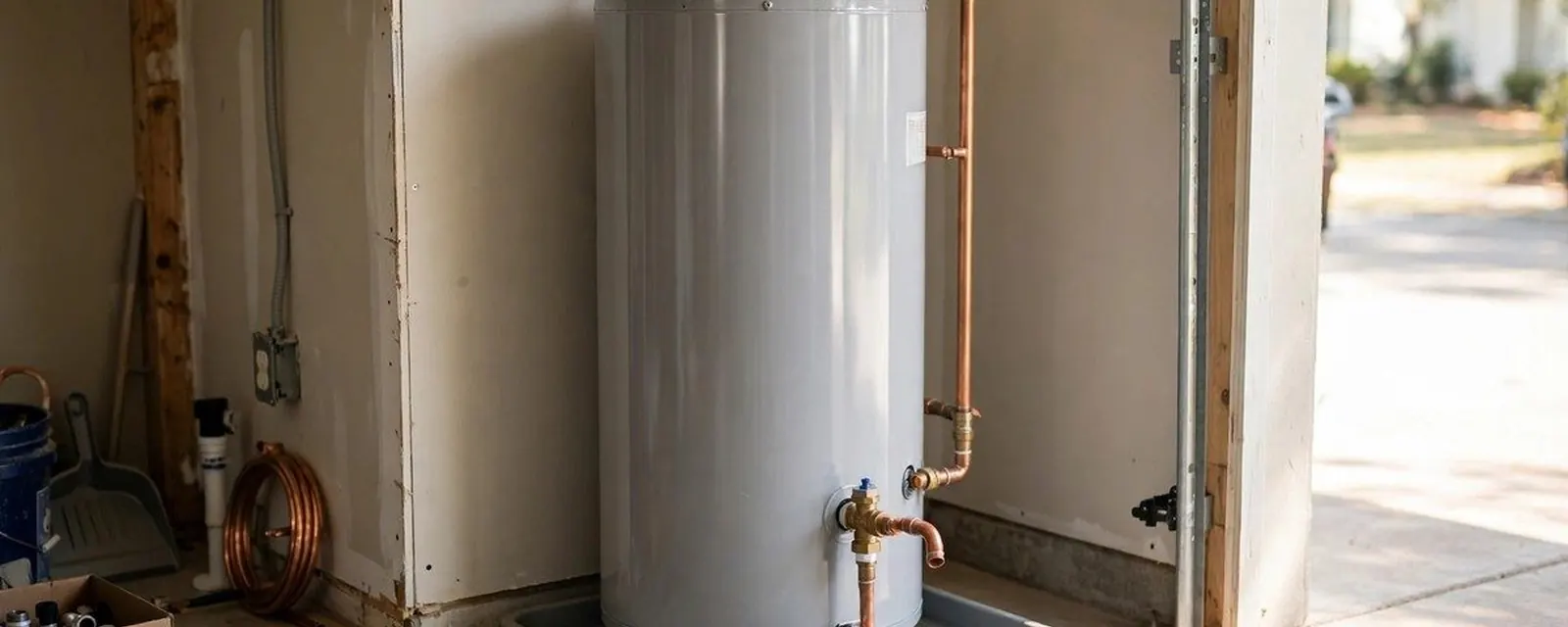
If your water heater has failed and the house has no hot water, call our 24/7 line. Water heater replacement is an emergency when the tank is flooding a floor or when a family cannot wash. We can often remove the old unit and set a new one the same day, depending on the schedule and the model.
Before we arrive, shut the cold water valve above the heater, switch off the breaker or the gas control, and clear a path to the unit. Take photos of the leak and the data label for your insurer.
Repair or replace? A decision table
Replacement makes sense when the cost and risk of keeping the old heater outweigh its remaining life. This table is how we talk it through.
| Situation | Our usual advice | Why |
|---|---|---|
| Leak from the tank body | Replace | A corroded liner cannot be repaired |
| Tank 10 or more years old with a failed part | Replace | The next failure is likely close |
| Tank under 6 years with a bad element or valve | Repair | The tank is sound and parts are inexpensive |
| Heater cannot keep up with the household | Replace with a larger or different type | Repair does not add capacity |
| Rusty hot water only | Inspect first | Could be the tank or the pipes |
If a repair makes sense, we say so. See water heater repair for what that involves.
A failed tank is an emergency: what replacement day looks like
A tank that is flooding a basement is an emergency, and a heater that stops making hot water in January is close behind. Shut off the cold water to the heater, switch off its gas or power, and call the 24/7 line. Replacement can often happen the same day when the schedule allows.
- Drain and disconnectWe shut off water and fuel, drain the tank to a floor drain or outdoors and disconnect the old unit.
- Remove the old heaterThe old tank leaves with us, and we clear the space.
- Set and connectThe new heater is leveled, connected to water with new flex connectors and valves and to fuel or power.
- Vent and safety partsGas models get a venting check. A temperature and pressure relief valve and discharge pipe are installed.
- Test and walk throughWe fill the tank, purge air, test for leaks and combustion, set the temperature and show you the shutoffs.
Most replacements finish in a few hours, though venting changes or access problems can add time. We tell you if we see one before we start.
Choosing a type for a New Hampshire home
Standard tank, gas or electric
The lowest first cost and the simplest swap. Pick the same fuel unless you are willing to change gas lines or wiring.
Heat pump (hybrid) tank
Uses much less electricity but needs space, air flow and a condensate drain. Basements often suit it.
Tankless
Heats on demand and takes less floor space. It needs a correct gas line or heavy electrical service, which can raise installation work. See our tankless page.
Larger tank or two units
For big households, a bigger tank or a pair of heaters avoids running out during back-to-back showers.
A heater that serves more people than it was sized for fails sooner. Tell us how many baths and how many people use hot water at once.
Sizing, expansion tanks and code updates
A new heater may need an expansion tank, a pressure reducing valve or a new vent liner so the system meets current plumbing code. Those items protect the heater and your fixtures. We explain each one and what it adds to the price before work starts.
Whether your swap needs a permit is a question for the town's Building and Zoning Enforcement office, 603-432-1100, extension 440.
Londonderry specifics: wells, sediment and cold winters
Many Londonderry homes use private wells, and sediment from a well shortens tank life. Test your water, and consider a sediment filter ahead of the heater. The state environmental agency runs programs for well testing, so ask them where to start.
Heaters in garages and unfinished basements work hard in January. A tank in an unheated space benefits from an insulated blanket where the manufacturer allows it, and from checked shutoffs before the freeze.
What water heater replacement costs
A swap is quoted before the old tank comes out. The cost depends on:
- Type and capacity of the new heater.
- Fuel and vent changes, and whether gas or electrical work is needed.
- Removal of the old tank and any floor protection or cleanup.
- Valves, connectors, expansion tank and drain pan.
- Dispatch outside regular hours.
Insurance often covers water damage after a tank bursts but not the heater itself. Photograph everything first. For a number tied to your home, call (603) 815-9179.
Replacement service across the area
We replace water heaters in every part of Londonderry and in Manchester, Litchfield and the other nearby towns. If you are planning ahead of a failure, see water heater installation for scheduled work.
A replacement tank is set up to the International Plumbing Code (IPC), including a relief valve, discharge pipe and a drain pan where the location requires one.
Questions we hear in Londonderry
Yes. Call (603) 815-9179 any time. If the tank has failed after hours, we stabilize the leak and schedule the swap for the earliest available time, often the same day.
Standard tanks commonly last 8 to 12 years, depending on water quality and care. A sediment-heavy well supply shortens that.
Yes, but the house needs the electrical capacity and an outlet or circuit. We assess it on site and describe the extra work.
Check with the town's Building and Zoning Enforcement office, extension 440 at 603-432-1100, before the swap.
Yes. Removal and disposal are part of the visit.
Call early and tell us the model and fuel. We bring a matching unit when possible.