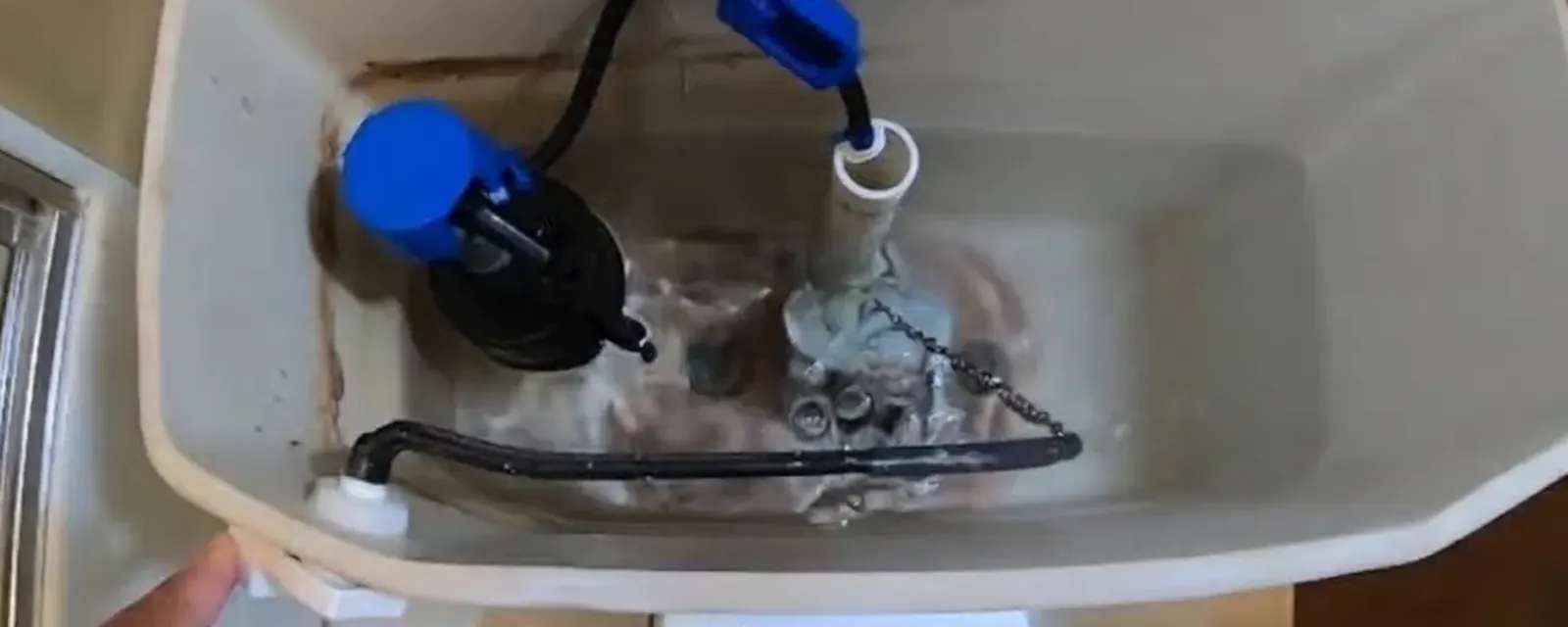
A toilet that runs, hisses or refills on its own is wasting water. In most cases the flapper, the rubber seal at the bottom of the tank, has worn out, or the fill valve, the tall device that refills the tank, has failed. Both are low-cost parts that you can replace without removing the toilet.
This guide shows how to tell which part is bad, how to replace each one, and when the problem is something else that deserves a plumber.
Which part has failed?
| Symptom | Likely cause | Part to replace |
|---|---|---|
| Tank refills every few minutes with no flush | Flapper not sealing | Flapper |
| Dye from the tank shows in the bowl after 15 minutes | Flapper leaking | Flapper |
| Hissing that never stops after a flush | Fill valve not shutting off | Fill valve |
| Water runs into the overflow tube | Float set too high or valve failing | Adjust float, then replace valve |
| Tank fills slowly or noisily | Worn fill valve or partly closed supply valve | Fill valve |
| Handle sticks or flapper stays up | Chain too short or too long | Adjust the chain |
Do the dye test first. A few drops of food coloring in the tank, no flushing for 15 minutes, and colored water in the bowl means the flapper leaks. If the bowl stays clear but you hear hissing, the fill valve is the culprit.
Tools and parts
- A universal flapper that fits 2 inch and 3 inch flush valves, or the exact model if you know it.
- A universal fill valve with adjustable height.
- Adjustable pliers or a wrench, a sponge and a small towel.
- A bucket for the water you will drain from the tank.
- A new supply line if the old one is cracked or stained.
Take a photo of the tank and the old parts before you shop. Flush valve openings come in two main sizes, and a mismatch is the most common reason a new flapper still leaks.
Replace the flapper
- Shut off the waterTurn the supply valve behind the toilet clockwise until it stops, then flush to empty the tank.
- Remove the old flapperUnhook the chain and lift the ears off the overflow pegs. Wipe the flush valve seat with a sponge so the new seal sits on a clean surface.
- Install the new flapperSnap the ears onto the pegs and hook the chain to the handle arm. Leave about half an inch of slack so the flapper can close fully.
- Test itOpen the supply valve, let the tank fill, flush, and run the dye test again.
If the seat is pitted or scaled, even a new flapper will leak. Clean it gently with a scouring pad, and replace the whole flush valve if the surface is cracked.
Replace the fill valve
- Drain and disconnectShut off the water, flush, and sponge out the remaining water. Place a towel under the supply connection and loosen the supply line nut at the base of the valve.
- Remove the old valveUnscrew the locknut under the tank and lift the valve out. Clear any debris from the opening.
- Set the new valveAdjust the height so the top sits about an inch above the overflow tube. Tighten the locknut by hand plus a quarter turn.
- Reconnect and adjustReattach the supply line, clip the refill tube to the overflow tube without pushing it inside, and turn the water on. Set the water level to the mark on the tank.
Do not overtighten plastic nuts. A cracked tank cannot be repaired, and the toilet must be replaced. If the old supply line is stiff or corroded, replace it while the water is off.
When a plumber is the better call
A new flapper and fill valve fix most running toilets. A toilet that still runs, rocks, leaks at the base or clogs often needs a different repair. Water around the base can mean a failed wax ring or a cracked flange, and both need the toilet lifted.
Our toilet repair and installation service handles flange, wax ring and fixture replacement, and the drain cleaning team clears toilets that will not flush properly. For an overflowing toilet, shut the supply valve, then call (603) 815-9179.
Londonderry, NH note: well pumps and fill valves
Many Londonderry homes run on private wells, and sediment or grit in well water can foul a new fill valve sooner than town water would. If a fill valve sticks within months, flush the supply line before you reconnect it, and consider testing your tap.
The New Hampshire Department of Environmental Services has programs that help private well owners test and treat their water, so ask them where to begin. If your toilet repair turns out to be a pressure problem, our dispatch covers Londonderry along with Derry and Hudson.
What toilet repairs cost
A fill valve and flapper job is a small repair, and the price still comes before the work. It depends on:
- Which parts are failing: flapper, fill valve, flush valve or a wax ring.
- Whether the supply line and shutoff valve are also worn.
- Whether the toilet has to be pulled and reset.
- Whether a new fixture is the better value.
- After-hours service.
Insurance usually does not pay for worn parts. For a real number, call (603) 815-9179.
Fill valves in new installations are expected to meet the anti-siphon rules in the International Plumbing Code (IPC).
Questions we hear in Londonderry
Rubber flappers wear and warp over the years, and water quality changes how fast. Replace it when the dye test shows a leak.
Most fit standard tanks. Check the height range and the tank hole size on the package before you buy.
The flush valve seat may be pitted, the chain may be too tight, or the fill valve may be set too high. Clean the seat and adjust the chain and float.
Not usually. A toilet that overflows or floods the floor is. Close the supply valve and call the 24/7 line.
It can if the water carries sediment. Test your tap, flush the supply line before connecting new parts, and ask NHDES about well testing programs.