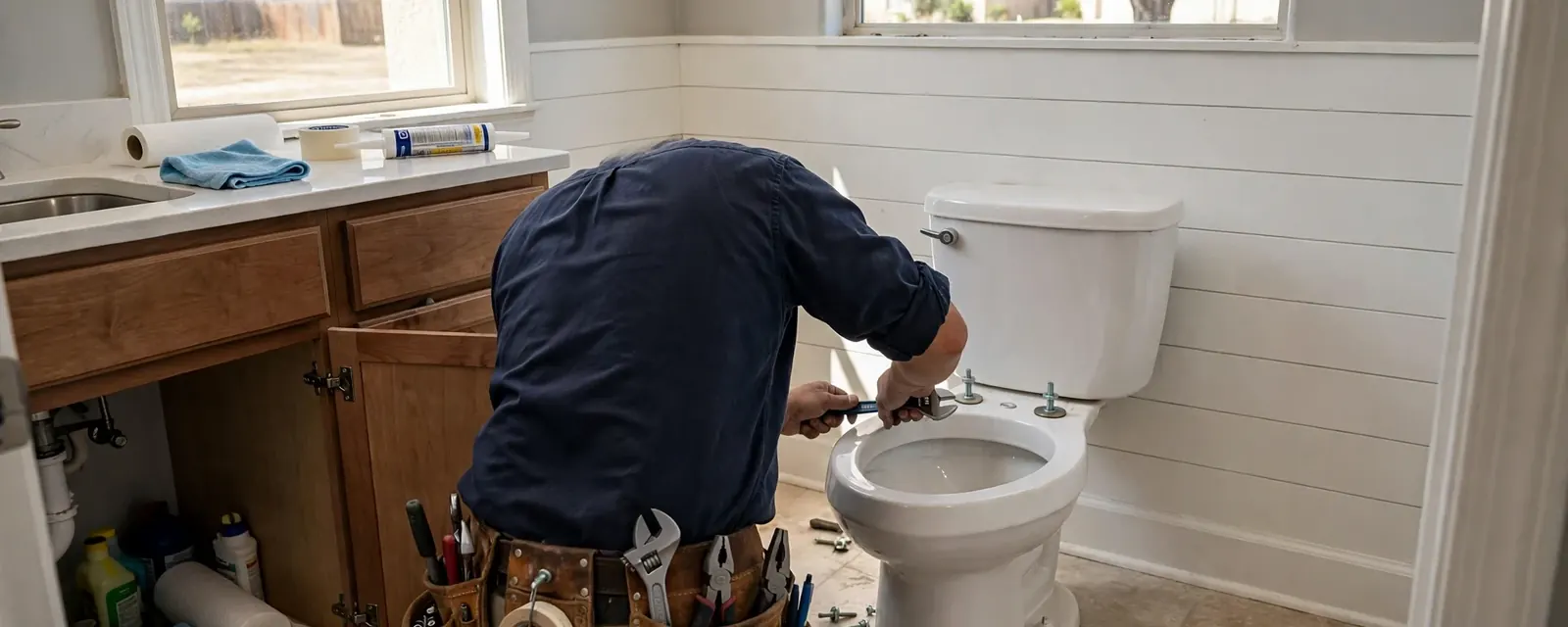
An overflowing toilet or a puddle spreading from the base is a plumbing emergency, because water on a bathroom floor reaches the ceiling below faster than most people expect. Call (603) 815-9179 at any hour. Dispatchers work nights, weekends and holidays, and a licensed plumber can usually be scheduled the same day.
While you wait, close the small valve on the wall or floor behind the toilet by turning it clockwise. Lift the lid and push the flapper down if water is still running into the bowl. Do not flush again, and put towels around the base.
Toilet repair covers leaks, weak or failed flushes, running water, loose bowls and replacement. We also install new toilets, including removal of the old one.
Toilet overflowing: what to do in the first five minutes
An overflow has one goal: stop more water from reaching the bowl. These steps work for most homes and take under a minute.
- Lift the tank lidPush the rubber flapper down into its seat. That stops the tank from emptying into the bowl.
- Close the supply valveTurn the oval handle behind the toilet clockwise until it stops. If it will not turn, use the main shutoff for the house.
- Do not plunge a full bowl yetPlunging an overflowing bowl pushes dirty water onto the floor. Let the level drop first.
- Protect the floorLay towels around the base and move rugs. Switch off power to any outlet that water has reached.
- Call the 24/7 lineTell the dispatcher whether other drains are gurgling. That points us toward the main drain and not just the toilet.
If sewage is coming up in a tub or floor drain too, stop using water in the house and call right away. That pattern means the clog is past the toilet, and our drain cleaning crew handles it.
Running toilet, weak flush and refilling on its own
A toilet that hisses or refills every few minutes has a worn flapper, a flapper chain that is too tight, or a fill valve that no longer shuts off. The water goes over the overflow tube or leaks past the flapper into the bowl. It is cheap water, but it adds up on a monthly bill, and a private well pump runs harder to feed it.
A weak flush is a different fault. The tank may fill to the wrong level, the flush valve may be partly blocked by mineral scale, or the rim holes under the bowl may be plugged. Most tanks should fill to about an inch below the top of the overflow tube.
Homes with two bathrooms often have two running toilets at once, because both flappers wear on the same schedule. We replace the flapper, fill valve and supply line together when the parts are the same age.
| What you notice | Common cause | Usual repair |
|---|---|---|
| Hissing, refills by itself | Worn flapper or fill valve | Replace flapper or fill valve |
| Handle must be held down | Chain too long or broken lever | Adjust chain, replace lever |
| Tank fills slowly | Clogged fill valve screen or half-closed supply valve | Clean or replace valve |
| Weak flush | Low tank level or blocked rim holes | Reset level, clear rim holes |
| Water on the floor after flushing | Failed wax ring or loose bolts | Reset the toilet with a new wax ring |
Leaks at the base, the tank or the supply line
Water at the base of a toilet can come from three places. A failed wax ring leaks between the bowl and the floor flange. A loose tank bolt or a cracked tank leaks from above, and a tired supply line leaks at the valve.
We dry the floor, run a flush and trace the water to its source before we pull anything. A rocking bowl, a stained floor around the base or a soft spot in the subfloor all point to a wax ring that has been leaking for a while. When the subfloor is damaged, we tell you before we set the toilet back down.
A cracked bowl or tank cannot be repaired, and replacement is the honest answer. If water is also showing up on the ceiling below, we trace the line with our leak detection service before closing the floor.
Toilet will not flush or keeps backing up
A bowl that fills and drains slowly usually has a clog in the trap, and a plunger or a closet auger clears it. A toilet that gurgles when the shower runs, or two toilets that both refuse to flush, points to the main drain.
Do not keep flushing. Each flush adds water that has nowhere to go. If a camera shows a root or grease blockage, hydro jetting clears the line more completely than a cable alone.
Wipes marked flushable do not break down like paper. They are a leading cause of toilet and septic trouble, so keep them out of the bowl.
Replacing or installing a toilet
Some toilets are not worth repairing. A cracked bowl, a toilet that has been reset three times, or a model that uses far more water than newer ones are all good reasons to replace. Most toilets sold today use 1.6 gallons per flush or less.
Before we start, we measure the rough-in, which is the distance from the finished wall to the center of the floor flange. Twelve inches is common. We also check whether the flange sits at floor level, because a flange set too low or cracked makes a new wax ring fail again.
- Round or elongated bowl, and whether the space allows an elongated one.
- Standard or comfort height seat.
- One piece or two piece design, and whether the tank fits your wall.
- Condition of the flange and the floor around it.
- A new supply line and shutoff valve, since the old ones rarely seal well after being moved.
Bring the new toilet or choose one with us. We carry out the old bowl, set the new one, test the flush and check every joint for drips before we leave.
What toilet repair costs
A toilet repair price is given before we pull the tank or the bowl. These factors change it:
- Whether the fix is parts only, such as a flapper, or a full reset with a new wax ring.
- Whether the flange or subfloor needs repair.
- Whether the toilet is being replaced, and which model you choose.
- Whether a clog sits in the toilet or farther down the drain line.
- Whether the call is after hours or on a holiday.
Homeowners insurance often pays for sudden water damage from an overflow but not for the toilet itself or gradual leaks. Check your policy. To get your own price, call (603) 815-9179 and describe the toilet.
Toilets in Londonderry homes
Many Londonderry households are on private wells, and sediment from a well can foul a fill valve screen. A toilet that fills slowly after the well pump cycles is worth a look. If your water has never been tested, ask the New Hampshire Department of Environmental Services about private well testing.
Whether your toilet drains to a town sewer or a septic tank changes what we look for. The Londonderry Department of Public Works, at 603-432-1100, extension 460, can tell you which applies on your street. Septic homes should keep wipes, cat litter and grease out of every drain.
We also repair and install toilets in Derry, Windham, Hudson and Manchester. For a leaking sink faucet or tub valve in the same bathroom, see our faucet repair page.
A toilet reset should leave a sealed flange and a trap arrangement that meets the International Plumbing Code (IPC) in New Hampshire.
Questions we hear in Londonderry
Yes. Overflow does not keep office hours, and (603) 815-9179 is answered all night. Tell us if water is on the floor or other drains are gurgling, and we can send someone the same day when the schedule allows.
A worn flapper or a fill valve that no longer closes lets water leak from the tank to the bowl, and the fill valve refills it. Replacing the flapper and fill valve usually ends it.
Water at the base after a flush, a toilet that rocks, a musty smell or a stain on the floor around the bowl all point to it. We reset the toilet with a new wax ring and check the flange.
Yes. We check the rough-in and flange, install the toilet with new hardware and a new supply line, and test it. If the model does not fit the space, we say so before we start.
Probably not. Gurgling in one fixture when another drains suggests a partial blockage in the main drain. A camera and cable usually find it.
Close the supply valve and let the level drop first. Then use a flange plunger with firm, steady strokes. If the water does not move after a few tries, stop and call.
A running toilet makes a well pump cycle more often and sends extra water to a septic tank. Both are worth avoiding, so fix a running toilet quickly.