A plumbing leak announces itself in odd ways. The water bill creeps up, the meter keeps turning when nobody is home, a ceiling stain appears, or a floor feels warm. Finding the source starts with a simple question: is water leaking somewhere, and is it before or after the main shutoff valve?
The steps below take about an hour. They separate leaks in fixtures, leaks inside walls and leaks in the buried line between the meter and the house, so you know whether a plumber needs to bring detection equipment.
Step one: confirm there is a leak with the meter
- Turn off everythingStop all water use. Shut off the ice maker, the dishwasher and the washing machine, and make sure nobody flushes.
- Read the meterFind the meter, usually in the basement or a meter pit near the street. Note the leak indicator, often a small triangle or dial that spins when any water moves.
- Wait and recheckWait 30 minutes with no use, then read it again. Any movement means water is leaking somewhere.
If the meter is moving, close the main shutoff valve inside the house and look at the meter again. If it still moves, the leak is in the line between the meter and the house. If it stops, the leak is inside the building.
Step two: check the fixtures that leak most
Toilets are the most frequent hidden leak. Add a few drops of food coloring or a dye tablet to the tank, wait 15 minutes without flushing, and look at the bowl. Colored water in the bowl means the flapper is leaking, and it can waste a lot of water with no sound.
Then check faucets, outdoor spigots and the water heater. Look under every sink for damp cabinets. Look at the water heater base, the relief valve pipe and the expansion tank. A wet floor around the heater points to the tank or a connection.
A leaking toilet is an easy repair, and our toilet repair page explains when to fix the flapper and when the fixture needs replacing.
Step three: read the signs inside walls and floors
| Sign | What it can mean | What to do |
|---|---|---|
| Warm spot on the floor | Leaking hot water line under a slab or in a floor | Shut off the water heater and call for detection |
| Ceiling stain that grows | Leak from a bathroom above or a supply line in the ceiling | Close the nearest shutoff valves and call |
| Musty smell in one room | Slow leak behind a wall or under flooring | Check with a moisture meter, call for detection |
| Sound of running water at night | Pressure leak in a supply line | Check the meter, then call |
| Peeling paint or bubbling wallpaper | Moisture traveling inside the wall | Mark the edge and watch if it spreads |
These signs rarely tell you the exact spot. Water can travel along a joist or a pipe for several feet before it appears. Opening drywall in the wrong place makes repairs bigger and does not find the leak.
Step four: the yard, the irrigation system and the buried line
A lush strip of grass, a soft patch or water at the surface after a dry week can mark a leak in the service line. Irrigation valves that run too long or lines that crack in winter also show up as wet spots. Turn the irrigation system off at its own valve and check the meter again.
If the meter moves with the main valve closed and the irrigation off, the leak is outside. That calls for equipment. Our water service line repair page covers buried supply line problems in detail.
When you need a plumber with leak detection gear
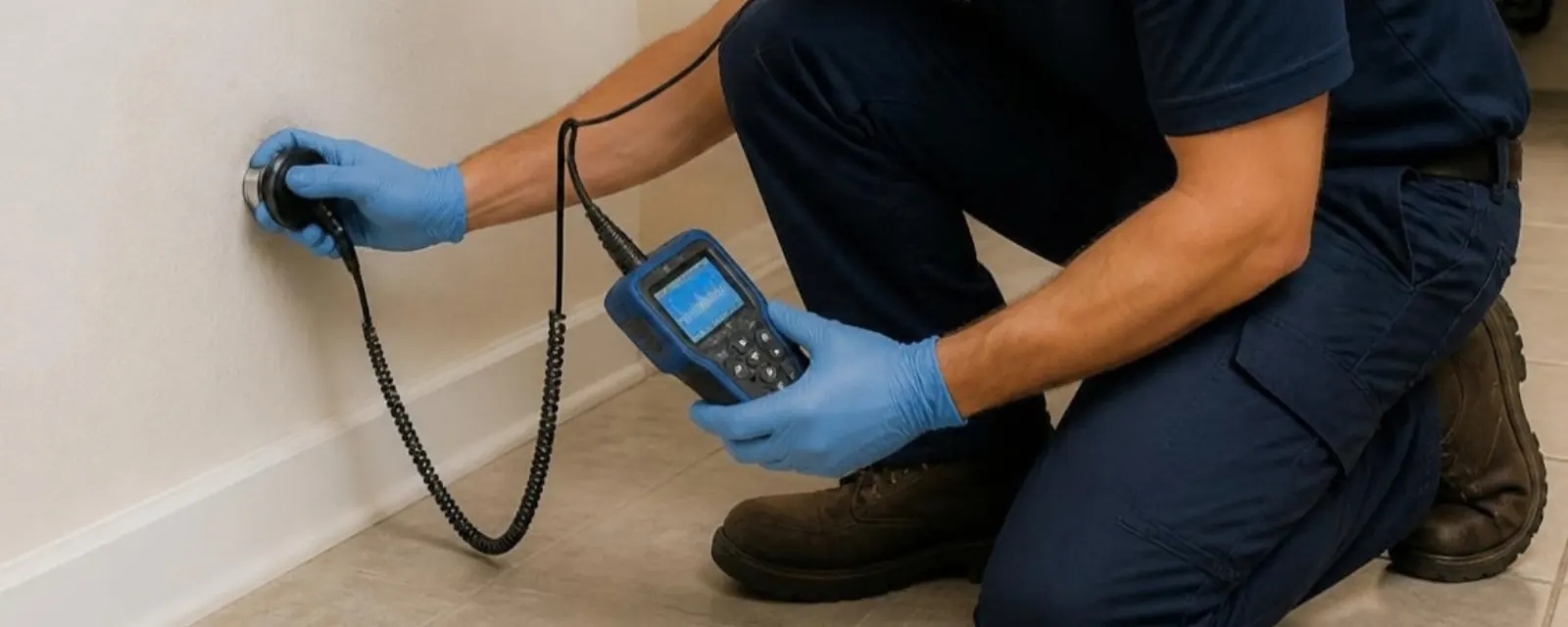
Pinpointing a hidden leak takes tools that a homeowner does not have. Plumbers use acoustic listening devices, thermal cameras, tracer gas and pressure tests. They mark the spot so a repair can open a small area and not a whole room.
Our leak detection service uses this approach and gives you the location before any wall or floor is cut. Call the 24/7 line at (603) 815-9179 if water is actively spreading, and close the shutoff valve nearest the leak while you wait.
Londonderry, NH note: meters, wells and the town
Meter location and meter type depend on the water supplier, so check your bill or ask your supplier before you read a meter. Some Londonderry households use private wells and have no town water meter. On a well, a leak shows up as a pump that runs often or a pressure tank that cycles quickly.
The town's 2026 construction list includes water main work on Old Nashua Road, Old Derry Road and South Road. If you live near that work and notice a sudden change in pressure or discolored water, ask Public Works at 603-432-1100, extension 460, before you suspect your own pipes.
We help homes in Londonderry, Windham and Litchfield, and we explain whether the problem is on your side of the system.
What finding a leak costs
Finding a leak and fixing it are priced separately, and you hear the price first. The cost depends on:
- Whether the leak is in a fixture, a wall, a floor or the buried line.
- The equipment needed to find it.
- How much access is needed to confirm the location.
- Whether the visit is after hours.
Insurance often covers the damage from a sudden leak but not the cost of finding or repairing a slow one. Check your policy, then call (603) 815-9179.
Once a leak is found, the fix should follow the International Plumbing Code (IPC) for pipe materials and supports.
Questions we hear in Londonderry
You can check fixtures, look for damp cabinets and use dye in toilet tanks. The meter is the best way to confirm a leak exists, so find it if you can.
A silent flapper leak can waste many gallons a day. Dye in the tank finds it in 15 minutes.
No. Seasonal use, a new appliance or a billing change can raise a bill. A meter that moves when everything is off is the proof.
Watch the pump. A pump that runs when nobody is using water, or a pressure tank that cycles quickly, suggests a leak. A plumber can pressure test the lines.
If water is discolored or tastes odd and you are on a private well, test the water. The New Hampshire Department of Environmental Services has programs for private well testing and treatment.