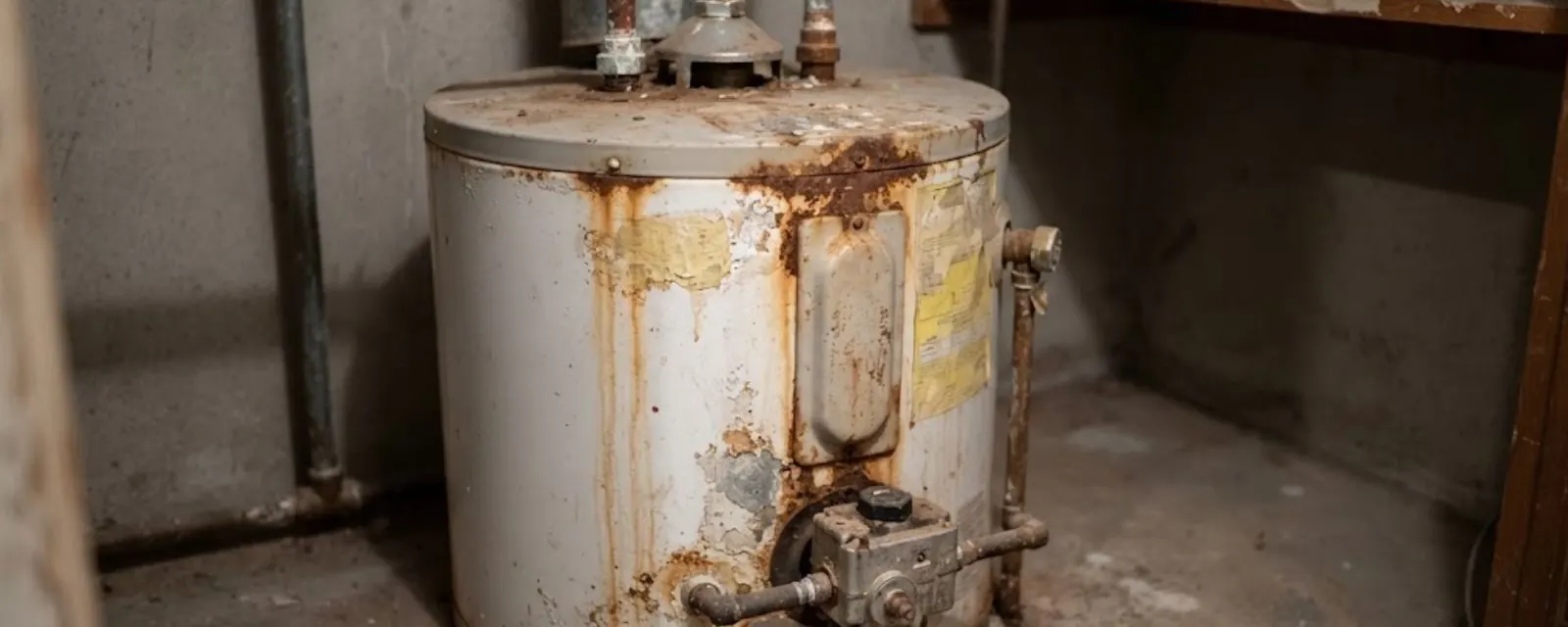
Most tank water heaters last roughly 8 to 12 years, and tankless units often last longer with regular maintenance. Those are ranges, not promises. Water quality, sediment, usage and maintenance all move the number up or down.
The real question is when to replace, and the answer is before the tank fails. A planned replacement costs less and causes less damage than a leak at 2 a.m. This guide shows how to read your heater's age and what signs matter.
How to read your water heater's age
Look for the data plate on the side of the tank. The serial number usually includes the month and year of manufacture, often as a letter and two digits. A letter for the month and the next two digits for the year are common, though each brand uses its own code, so check the manufacturer's chart.
If you cannot read the plate, check the paperwork from the install or look at how the system has behaved. A heater older than ten years deserves a yearly look, whatever the brand.
| Type | Typical working life | What shortens it |
|---|---|---|
| Gas tank | About 8 to 12 years | Sediment, no tank flushing, corroded anode rod |
| Electric tank | About 10 to 15 years | Burned-out elements, sediment, hard water |
| Tankless | Often 15 to 20 years | Scale buildup, no yearly flush |
| Heat pump (hybrid) | Around 10 to 15 years | Dirty filters, poor air flow |
Warning signs the heater is near the end, and when to call
- Rusty or discolored hot water.
- Rumbling or popping noises from the tank as sediment cooks.
- Moisture or small puddles near the base.
- Hot water that runs out faster than it used to.
- Frequent repairs to the thermostat, elements or burner.
- A tank that is over ten years old and has never been flushed.
A puddle at the base of a tank is the one sign that cannot wait. The inner tank has probably failed, and no repair will fix it. Close the cold water valve at the heater, turn off the gas or the breaker, and call our 24/7 line at (603) 815-9179.
What shortens a heater's life
Sediment is the biggest factor. Minerals settle at the bottom of the tank, insulate the burner or elements and cause hot spots. Flushing the tank once a year slows that process.
The anode rod is the second factor. It is a sacrificial metal rod that corrodes first and protects the tank steel. When it is used up, the tank starts to rust. Replacing a worn rod can add years, and our water heater repair service covers it.
Water pressure and temperature settings matter as well. High pressure stresses the tank and fittings. A thermal expansion tank on a closed system protects the tank from pressure swings.
Repair or replace?
Use age, the type of failure and the repair price to decide. A thermostat, element, igniter or relief valve is a repair on a heater that is still sound. A leaking tank is always a replacement.
- Replace if the tank leaks, rust shows on the outside or the water runs rusty.
- Replace if the unit is past 10 to 12 years and needs a significant repair.
- Repair if the heater is under about eight years old and the part is minor.
- Think about a different type if your hot water needs have changed.
Our water heater replacement page explains what a swap involves, and the tankless water heater page covers that upgrade for homes that want it.
Planning a replacement before it fails
Pick a replacement date when the heater passes year ten, even if it still works. Measure the space, note the fuel type and check that the vent, gas line or electrical circuit are in good shape. Those details decide how long the job takes.
Think about size too. A household that has grown or shrunk may need a different tank, and a high-demand home may do better with a tankless unit. Ask your plumber to compare the options in writing. Replacing on your schedule lets you shop and compare instead of buying whatever is available on the day a tank fails.
Finally, know where your main water valve and your heater's shutoff valves are. If the tank ever leaks, closing them takes seconds and limits the damage.
Londonderry, NH note: water quality and heater life
Water quality shapes how fast sediment and scale build up. We cannot quote a hardness number for Londonderry, because supply differs between town water and private wells, and no single figure applies. Test your tap, or ask your water utility for its annual water quality report.
If you are on a private well, ask the New Hampshire Department of Environmental Services about testing and treatment programs, and flush your tank on a schedule that matches what the test shows. Whether a water heater swap needs a permit is the town's call, and the answer is a short call to 603-432-1100, extension 440.
We replace heaters in Londonderry, Hudson and Manchester and can advise on a schedule for your own tank.
What replacement costs
Replacement costs differ by tank type and site, and we quote before any work. The total is set by:
- Tank size and fuel type, such as gas, electric or heat pump.
- Venting, gas line or electrical changes needed.
- Whether the old heater can be reused in the same space.
- Expansion tank, new shutoff valves and code upgrades.
- Emergency or same-day service.
Insurance may cover water damage from a sudden leak, but it does not pay to replace a heater that wore out. For a number, call (603) 815-9179.
A new tank must include a relief valve and discharge pipe under the International Plumbing Code (IPC).
Questions we hear in Londonderry
Roughly 8 to 12 years is typical, and yearly flushing helps. The age on the data plate is the starting point.
It can be. If only hot water is rusty, the tank or anode rod is failing. If cold water is rusty too, the problem may be in the pipes.
Flush it yearly, check the anode rod, set the temperature moderately and keep the relief valve working.
Close the cold water valve at the heater, cut the gas or power, and call the 24/7 line. Put a bucket under the tank.
Test your tap first. A test shows whether sediment or minerals could shorten the life of a new heater. NHDES can point you to testing programs.