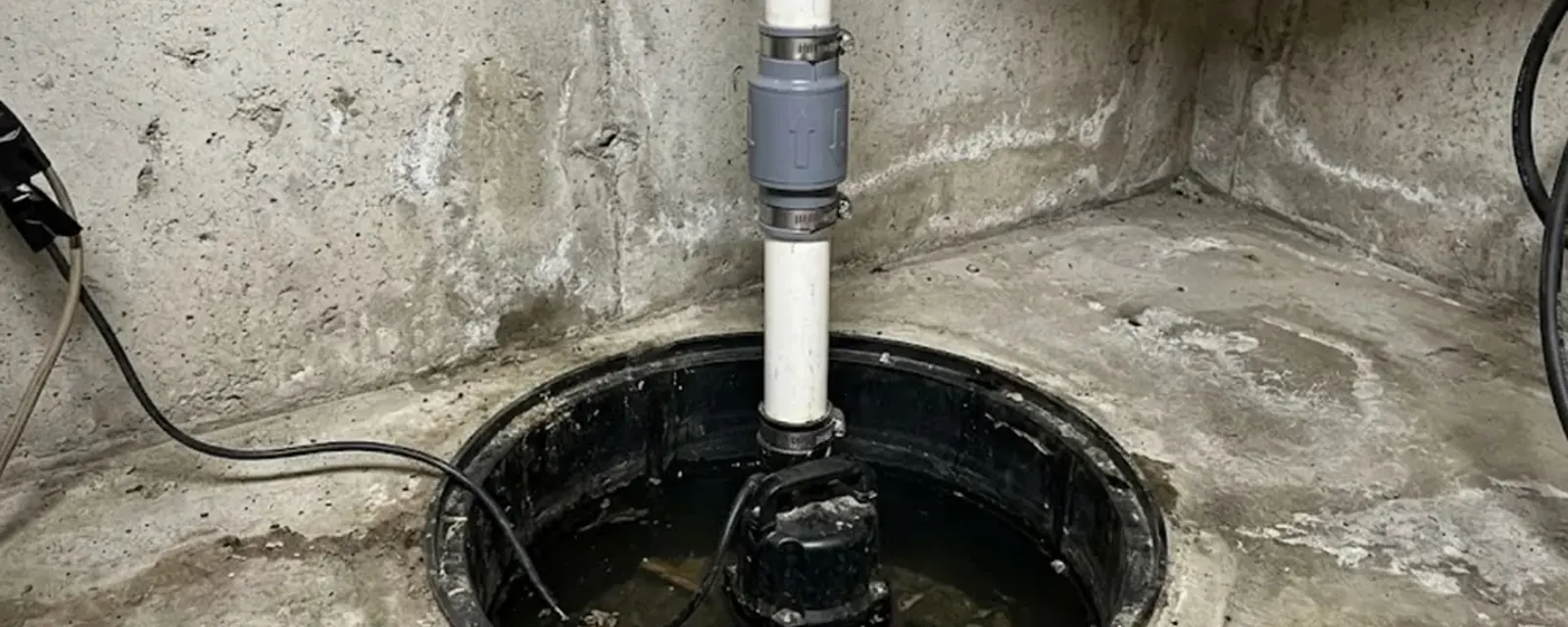
A sump pump installation puts a collection pit in the lowest part of your basement or crawlspace, sets a pump in it and runs a discharge pipe outside. When groundwater rises, the pump moves water out before it spreads across the floor. The job is simple in concept, but the details decide whether it works when a storm hits.
This guide explains the pump types, the parts around the pump that matter as much as the pump itself, and the questions to ask any contractor. We do not install foundation drainage systems as a standalone product, so for the plumbing side of a sump setup we can help through our plumbing installation team, and for tracing basement water we use leak detection.
Do you actually need a sump pump?
Not every wet basement needs a pump. Water in a basement can come from a high water table, roof and yard runoff, a leaking supply line, a failed floor drain or a sewer backup. A pump only helps the first two.
Before a pit is cut into your floor, rule out plumbing sources. A meter that keeps spinning with everything off, a hissing wall or a damp patch that appears in dry weather all point to a leak and not groundwater. A plumber can check that in under an hour.
- Water appears along the wall or floor joint after heavy rain or snowmelt.
- The basement smells musty and the floor stays damp for days.
- A floor crack weeps in spring.
- Stored items on the floor show water lines.
- A neighbor on a similar lot already runs a pump.
Pedestal or submersible pump?
| Feature | Pedestal pump | Submersible pump |
|---|---|---|
| Motor location | Above the pit, on a stem | Sealed inside the pit |
| Noise | Louder, you hear it run | Quieter, muffled by water |
| Pit size needed | Narrow pit works | Needs a wider pit |
| Service | Easy to reach | Pulled from the pit |
| Typical lifespan | Often longer in a dry pit | Handles heavy use well |
| Best for | Tight spaces, light use | Heavy water, finished basements |
A submersible is the usual choice for a home that sees real water. A pedestal pump suits a small crawlspace or a light, occasional flood. Ask your installer why they picked the one they did, and what its flow rating is in gallons per hour at your discharge height.
The parts around the pump
A pump alone is not a system. The pit liner, lid, float switch, check valve and discharge pipe determine how reliably the water leaves.
Pit and liner
A pit with a solid liner and a sealed lid keeps debris and radon-laden soil air out of the basement.
Float switch
This tells the pump when to start and stop. A float that snags the side of the pit is the number one cause of pump failure.
Check valve
It stops water in the discharge pipe from running back into the pit after the pump shuts off.
Discharge pipe
It should carry water well away from the foundation and not end up where it can run back toward the house.
The outlet matters too. Use a dedicated ground-fault protected outlet, and do not run the pump from an extension cord. A power outage during a storm is when you need the pump most, which is why we talk about battery backup below.
Battery backup and alarms
Storms knock out power, and a pump with no power does nothing. A battery backup pump sits beside the main pump and takes over when the power drops or the primary fails. A water level alarm adds a warning if the pit fills anyway.
A backup is not a generator. A battery gives hours of pumping in a light flood, not days. If you lose power often, ask about a larger battery bank or a generator transfer plan.
Where the water goes
The discharge line needs a destination that will not send water back to your own basement or into your neighbor's yard. Pipe it to a downhill part of the lot and spread it with a splash block or a buried extension.
Do not connect a sump pump to a sanitary sewer line or a septic tank. Pumped groundwater can overload a septic system, and many towns prohibit sump connections to the sewer. Ask your installer how your lot handles the discharge, and ask the town if you are unsure.
What sump pump installation costs
Sump work is quoted before it starts. The bill is driven by:
- Whether a new pit must be cut into a concrete slab or an existing pit is reused.
- The pump type, horsepower and whether a backup is added.
- Discharge pipe length, the number of bends and where the water ends up.
- Electrical work for a ground-fault outlet and a dedicated circuit.
- After-hours or emergency dispatch.
Homeowners insurance often excludes groundwater and sump failure unless an endorsement was added, so check your policy. For a real number, call (603) 815-9179.
Londonderry, NH note: drainage and permits
Londonderry sits on the Merrimack River watershed. Beaver Brook drains the east and south parts of town, and Little Cohas, Watts, Colby and Nesenkeag Brooks drain the west. Homes near those brooks and at the base of rises such as Number Eight Hill may see more groundwater after storms, so ask neighbors on your street whether their basements stay dry.
Before you cut a floor or add a new circuit, call the town Building and Zoning Enforcement desk (603-432-1100, extension 440), since what needs a permit changes with the job. Water coming off a road or ditch is a question for Public Works, extension 460, which can say who owns the drainage.
Where a sump discharges is a code question, and plumbing portions follow the International Plumbing Code (IPC).
Questions we hear in Londonderry
A simple replacement can be done in a few hours. Cutting a new pit through a concrete slab, running a discharge line and adding a backup can take a full day or more.
Many pumps run for several years under normal use, and wear faster in heavy use. Test yours each spring by pouring a bucket of water into the pit.
If your basement has finished space or stored valuables, yes. Storms and outages tend to arrive together.
No. Groundwater can overload a septic tank and is not allowed in many sewer systems. Ask the town and your plumber about the right discharge.
Check the meter with all fixtures off. If it still moves, the cause is a plumbing leak. If the water shows up only after rain or snowmelt, it is groundwater and a pump may help.
Seasonal wetness points to a rising water table or snowmelt. A pump helps, but fixing gutters, grading and downspouts first can cut the load. Ask a plumber to look at the basement before you decide.
We serve homes around Londonderry and in Windham and Derry, where basements and wells are common. When a pump discharge or a failed supply line floods a floor, our burst pipe repair service can shut the water off and start repairs.