Your sewer line carries every drop from sinks, tubs, toilets and appliances out to the town main or to a septic tank. When it cracks, sags, fills with roots or collapses, the symptoms show up inside the house first. Knowing them early often means a cleaning or a spot repair instead of a dig.
Below are the signs that most often point to the line and not to a single fixture. If sewage is entering the house right now, skip ahead to the checklist and call our 24/7 line.
Seven signs the sewer line is the problem
One slow drain usually means a local clog. Patterns across the house point to the main line.
Several fixtures drain slowly
Sinks, tubs and a toilet all slow down together. The shared drain downstream is restricted.
Gurgling and bubbling
A toilet gurgles when the washer drains, because air is pushed back through the traps.
Sewage smell indoors or outside
A cracked or open joint lets gas escape near the foundation or in a basement.
Backups in the lowest drain
A basement floor drain or bathtub fills first because it sits closest to the blockage.
Wet or sunken lawn patches
A soggy strip or a dip in the yard marks a leaking or collapsed line.
Repeat clogs
A line cleared months ago clogs again. Roots or a belly in the pipe holds debris.
Cracks, mold or rodents
Foundation cracks and nests near a pipe path can follow a failing line.
What to do if sewage is backing up
- Stop using water in the house, including toilets, the dishwasher and the washing machine.
- Keep children and pets out of the affected room.
- Open windows and keep the area ventilated.
- Photograph the water and affected items for your insurer.
- Call the 24/7 line at (603) 815-9179 and say which drains are backing up.
Do not pour chemical cleaners into a backed-up line. They sit in the pipe and endanger anyone who opens it. A plumber needs a clean access point and a camera to find the cause.
Why sewer lines fail
Older lines were built from clay, cast iron or a fiber material called Orangeburg. Clay joints let roots in. Cast iron rusts from inside out. Orangeburg deforms over time and can collapse. Newer lines in PVC fail for different reasons, mostly poor bedding or settling.
Ground movement matters too. Freeze and thaw cycles in New Hampshire move soil, and a pipe that is not evenly supported can sag. A sag, or belly, collects waste and invites repeat clogs.
| Pipe type | Common failure | Typical repair path |
|---|---|---|
| Clay | Root intrusion at joints | Root cutting, then lining or spot repair |
| Cast iron | Rust scale and cracks | Cleaning, then lining or replacement section |
| Orangeburg | Collapse or flattening | Replacement |
| PVC or ABS | Separated joint or belly | Spot repair or regrading |
How a camera inspection confirms the damage
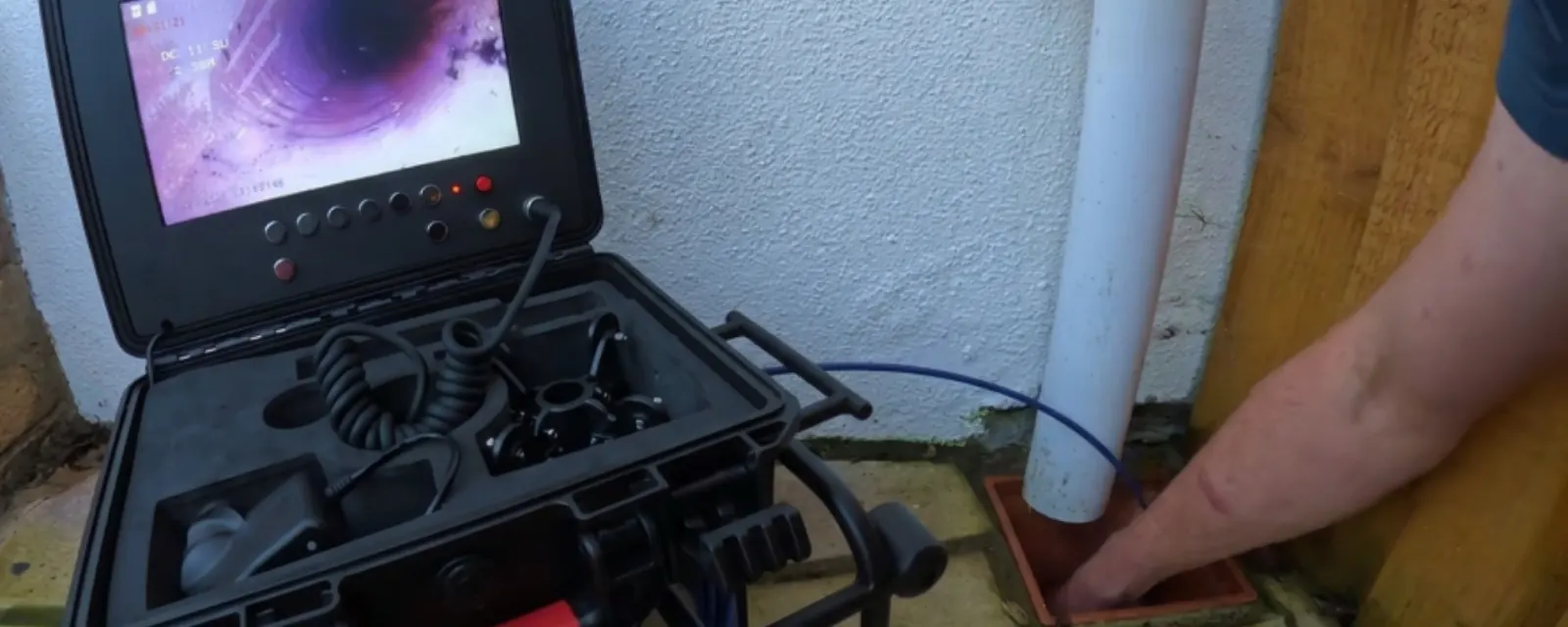
A sewer camera on a flexible cable travels from a cleanout toward the street or the tank. It shows roots, cracks, offset joints and bellies on a screen, and it records the distance to each defect. That measurement tells us where a repair has to happen.
Cleaning comes first when roots or grease hide the pipe. Our sewer line cleaning work opens the line so the camera can see it. The sewer inspection page explains what you receive afterward.
If the camera shows a cracked or collapsed section, we describe the repair options with their trade-offs. Sewer line repair can mean spot digging, pipe lining or replacing a run, depending on depth and condition.
Repair paths and trade-offs
- Spot repair works when one section is broken and the rest of the pipe is sound.
- Lining makes a new pipe inside the old one and avoids digging, but the old pipe must be clean and mostly round.
- Replacement is the answer for a collapsed or badly bellied line, and it needs excavation.
- Cleaning alone buys time when roots are the only issue, but it does not fix a cracked joint.
Ask for the camera video and the measured distance before you approve any digging. A clear picture of the defect is the best protection against unnecessary work.
Londonderry, NH note: town sewer or septic
Before a repair, find out where your line ends. Some Londonderry properties connect to the town sewer and others use a septic system. Public Works can confirm whether your house is on the town sewer, at 603-432-1100, extension 460.
That answer changes what a backup means. On a town connection, the blockage may sit in your private line or in the street main, and a camera shows which. On a septic system, a backup may point to a full tank or a failed leach field, and a plumber and a septic pumper may both be needed.
We handle homes in Londonderry, Derry and Manchester, and we tell you plainly when the problem belongs to the town or to a septic contractor.
What sewer line repair costs
Sewer repair prices vary widely, so we state ours before digging or lining begins. They depend on:
- Depth and length of the damaged section.
- Pipe material and diameter.
- Whether the line passes under a driveway, a patio or landscaping.
- Whether lining or excavation is the right method.
- Whether the work is an emergency visit.
Insurance rarely pays for gradual pipe failure, though some policies cover the water damage from a sudden backup. Call (603) 815-9179 for a number on your line.
A replacement line is built to the International Plumbing Code (IPC) for slope, material and cleanouts.
Questions we hear in Londonderry
If more than one fixture backs up or the lowest drain overflows first, the main line is the likely location. A camera confirms it.
Roots rarely crack a sound pipe, but they enter joints and cracks, grow into a mass and then hold the opening wide. Cutting them clears the flow, and lining or repair stops them returning.
It can be. A smell near the foundation or over the pipe path may mean a leaking joint. A camera or a smoke test locates the opening.
A spot repair may take a day. Lining and replacement take longer, and the camera findings set the schedule.
Call Londonderry Public Works at 603-432-1100, extension 460. Our camera shows whether the problem is in your private line first.