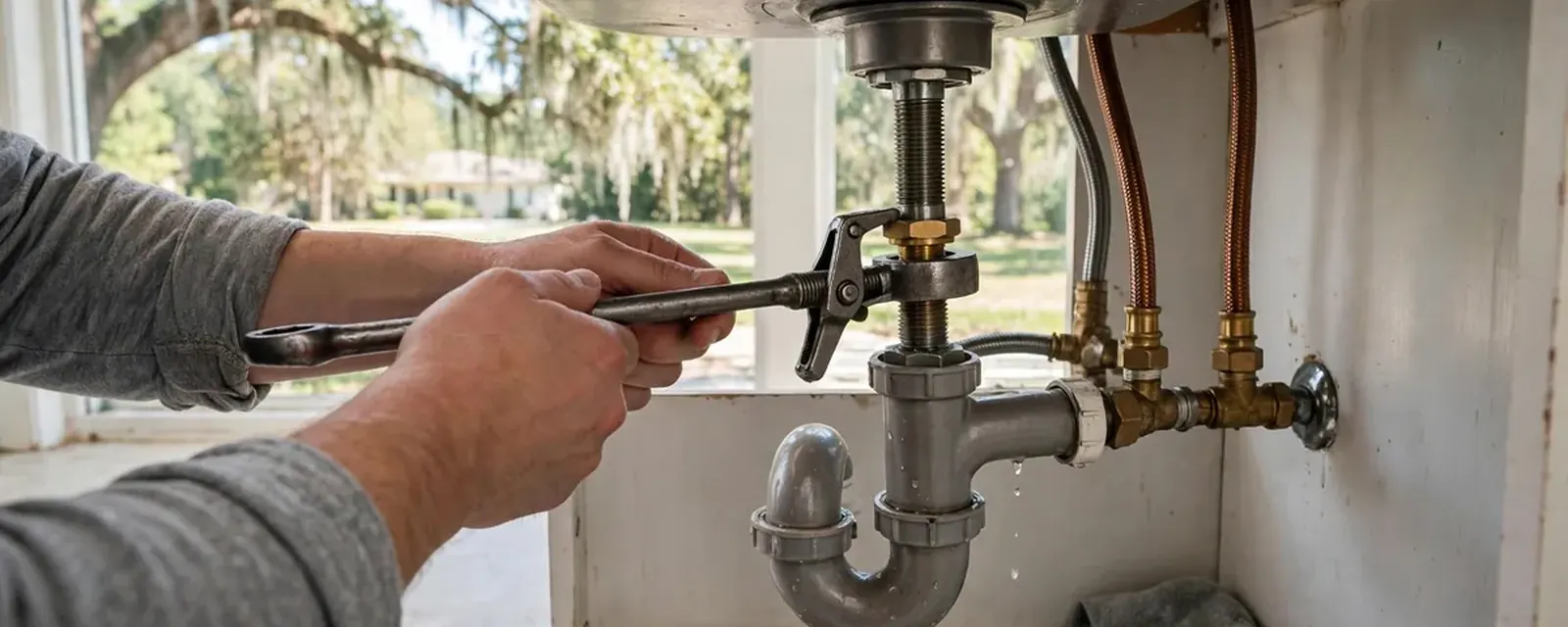
A bathroom sink has only a few parts that wear out: the drain stopper and trap, the faucet cartridge, the supply lines and the shutoff valves. Once you know which one is failing, the repair is usually small. This guide walks through each symptom, what you can safely do yourself, and where a licensed plumber saves you from a bigger repair.
Start by emptying the vanity cabinet and putting a dry towel on the floor. Then run the water and watch. Whether the water shows up at the drain, the faucet spout or the pipes under the basin tells you where to look next.
Match the symptom to the part
Use this table before you pick up a wrench. It saves most homeowners a trip to the hardware store for the wrong part.
| What you see | Part most likely failing | Usual fix |
|---|---|---|
| Water drains slowly or gurgles | Pop-up stopper, trap or branch drain | Clean the stopper and trap, then cable the drain |
| Drip from the spout when the faucet is off | Cartridge, washer or seat | Replace the cartridge or washer |
| Water under the sink only while running | Drain connection or trap nut | Reseat the washer and tighten by hand plus a quarter turn |
| Water under the sink all the time | Supply line or shutoff valve | Replace the line or the valve |
| Weak or uneven spray | Aerator or faucet cartridge | Soak or replace the aerator |
Slow or clogged bathroom sink drains
Hair and soap scum wrap around the pop-up stopper and then collect in the trap. Pull the stopper straight up or unscrew the pivot nut behind the drain pipe, and wipe it clean. You will usually be surprised by what comes out.
Next, put a bucket under the trap, loosen the two slip nuts, and rinse the trap in another sink. A bathroom sink drain is typically 1.25 inches wide, so it narrows fast. Reassemble the trap with the washers seated flat.
If the sink still drains slowly with a clean trap, the blockage sits farther along the branch line. A hand auger can reach it, but a drain that keeps returning needs a camera look. Our drain cleaning service handles both.
A dripping or weak faucet
A faucet that drips from the spout has a worn cartridge, washer or valve seat. Shut off the two valves under the sink, take the handle off, and pull the cartridge. Match the part number at a plumbing supply counter and replace it. This takes about thirty minutes on most single-handle faucets.
A weak stream is often just the aerator, the small screen at the spout tip. Unscrew it, rinse out the grit and reinstall it. If the stream is still weak, check whether the low pressure shows up at other fixtures too. Pressure that is low everywhere points to the water line, not the faucet.
When the faucet body itself is corroded or the handles feel loose, replacement is cheaper than repeated repairs. Our faucet repair page explains how we decide between a repair and a new fixture.
Leaks under the vanity
A wet cabinet floor is the most common reason people call a plumber about a bathroom sink. The leak comes from one of three places, and a dry paper towel held at each joint will find it.
- Check the drain connectionsRun the sink with the stopper open and dry each slip nut with a paper towel. A wet towel at a nut means a loose connection or a cracked washer.
- Check the supply linesWipe each braided line from the valve to the faucet. Drips at the ends mean a worn rubber washer. A bulge or rust on the braid means replace the line.
- Check the shutoff valvesTurn the valve handle slightly and watch the stem. A weeping stem needs a new valve, and old quarter-turn valves that no longer close fully should be replaced at the same time.
A leak that returns after you tighten everything may be coming from the sink basin overflow or from a pipe in the wall. In that case, stop using the sink and shut off the water to it. Our leak detection service finds hidden leaks without opening walls first.
When to stop and call a plumber
- Water is dripping from the ceiling below the bathroom.
- The shutoff valve will not turn or leaks when you touch it.
- The supply pipe in the wall is corroded or the escutcheon plate is stained.
- More than one fixture drains slowly at the same time.
- Water is spreading across the floor and you cannot find the source.
If water is actively spreading, close the shutoff valves under the sink first. If they will not close, shut off the main water valve and call our 24/7 line at (603) 815-9179. Emergency calls go straight to a dispatcher.
Londonderry, NH note: private wells and sink parts
Many Londonderry households draw water from private wells, and the town has been working on a plan to extend public water to more areas. If your sink aerator clogs often or a faucet cartridge wears out quickly, the water itself may be carrying grit or minerals.
We cannot give a hardness number for your house, and no single figure applies to every well. Test your tap and read the results before you buy a filter or replace fixtures. The New Hampshire Department of Environmental Services runs programs that help private well owners test and treat their water, so ask them where to start.
If you want a plumber to look at pressure or fixtures after a test, we serve Londonderry as well as Windham and Derry, where many homes also depend on wells.
What bathroom sink repairs cost
Sink repairs range from a new supply line to a rebuilt drain, and the price is set before we begin. These factors change the total:
- Whether the faucet is repairable or needs replacing.
- Access to the shutoff valves and the age of the old ones.
- Whether a drain needs cabling or only a trap cleaning.
- Pipe material in the wall, such as copper, galvanized steel or PEX.
- Time of day, since after-hours calls cost more.
Homeowners insurance often covers sudden water damage but not the repair of the worn part itself. For your number, call (603) 815-9179.
Trap arms, vents and supply stops should meet the International Plumbing Code (IPC), which is the standard a New Hampshire inspector uses.
Questions we hear in Londonderry
Yes, on most single-handle faucets. Shut off both valves, remove the handle, pull the cartridge and match the part at a supply counter. If the valve seat is pitted or the faucet is old, replacement of the whole fixture is cheaper.
The blockage is probably farther along the branch line or the vent is partly blocked. A cable usually clears the branch. If it returns within weeks, a camera inspection shows why.
Hand tight plus about a quarter turn. Overtightening cracks plastic nuts and washers, and that creates the leak you are trying to fix.
A slow drip can wait for a daytime visit if you close the shutoff valves and keep a bucket underneath. A steady stream or water reaching a ceiling below is an emergency.
Yes if you are on a private well and fixtures clog or wear out fast. A water test shows what is in the supply. Ask the New Hampshire Department of Environmental Services about private well testing programs.